Somewhere between “I have a great business idea” and “I’m actually running a business,” there’s a mountain of paperwork most people don’t talk about enough. The business registration process in India isn’t as scary as it looks once you break it into steps — but it does trip up a lot of first-timers.
I remember helping a cousin register her small handicrafts export business. She’d delayed it for almost eight months, assuming it would take weeks and cost a fortune. It took eleven days.
Why Registering Your Business Matters
Direct answer: Registering a business gives it legal identity, protects personal assets from business liabilities, and makes it eligible for loans, government schemes, and GST registration — all things an unregistered business simply can’t access.
Skipping registration might feel easier at the start. But try opening a current bank account or applying for a business loan without it. You’ll hit a wall fast.
Choosing the Right Business Structure
This decision shapes everything after it, so don’t rush it.
- Sole Proprietorship — simplest, best for very small, single-owner setups
- Partnership Firm — for two or more owners sharing responsibility
- Limited Liability Partnership (LLP) — limited liability with partnership flexibility
- Private Limited Company — best if you’re planning to raise investment later
Most small businesses in India start as sole proprietorships, then convert to a Private Limited Company once they’re ready to scale or bring in investors.
A Quick Reality Check
A Private Limited Company involves more compliance — annual filings, audits, board meetings. If you’re a one-person consulting business, that’s overkill. Match the structure to where your business actually is today, not where you hope it’ll be in five years.
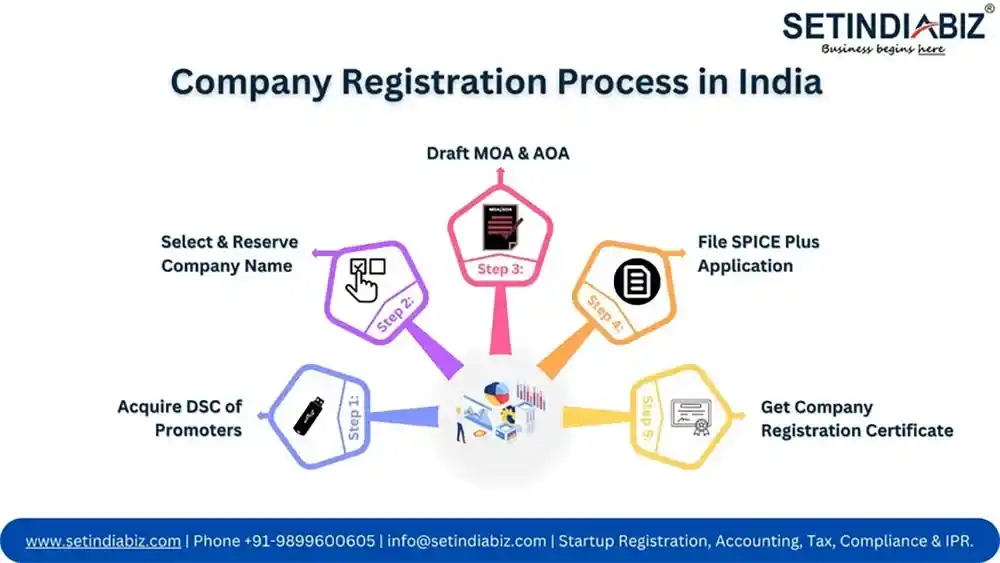
Step-by-Step Business Registration Process
- Decide your business structure (see above)
- Obtain a Digital Signature Certificate (DSC) if registering as LLP or Pvt Ltd
- Apply for Director Identification Number (DIN), if applicable
- Reserve your business name through the MCA portal
- File incorporation documents (MOA, AOA for companies)
- Get your Certificate of Incorporation
- Apply for PAN and TAN
- Register for GST if turnover crosses the threshold
For a sole proprietorship, honestly, steps 2-6 don’t even apply — you just need a GST registration, a current bank account, and maybe a Shop and Establishment license depending on your state.
Documents You’ll Actually Need
- PAN card of all directors/partners
- Address proof (Aadhaar, passport, or voter ID)
- Proof of registered office (rent agreement or utility bill)
- Passport-size photographs
- No Objection Certificate from the property owner, if rented
Keep scanned copies ready before you start — this alone saves days of back-and-forth.
How Long Does It Take
For a Private Limited Company, expect 7-15 working days if documents are in order. Sole proprietorship registration under GST can be done in as little as 3-5 days. LLP registration usually falls somewhere in between.
[link to related guide about GST registration here]
Costs Involved in Registration
Government fees vary by state and structure, but roughly:
- Sole Proprietorship: ₹2,000 – ₹5,000 (mostly GST and license fees)
- LLP: ₹5,000 – ₹10,000
- Private Limited Company: ₹8,000 – ₹15,000, depending on authorized capital
Professional fees for a CA or company secretary usually add another ₹3,000-₹10,000, though plenty of founders now do it themselves through the MCA’s online portal.
Common Mistakes to Avoid
Don’t pick a business name too close to an existing trademark — it gets rejected and wastes time. Don’t skip GST registration just because turnover seems low right now; if you’re growing fast, you’ll need it sooner than you think.
[link to related guide about business plan writing here]
FAQ
Q: Is business registration mandatory in India? Not always, but it’s strongly recommended. Some form of registration is needed to open a business bank account or apply for loans.
Q: What is the fastest way to register a business? Sole proprietorship through GST registration is generally the quickest, often completed within a week.
Q: Can I register a business from home? Yes. Your home address can serve as the registered office, provided you have proper address proof.
Q: Do I need a CA for business registration? Not strictly, but it helps avoid document rejection and speeds things up, especially for LLP and Pvt Ltd registrations.
Q: What happens if I don’t register my business? You risk personal liability for business debts and lose access to loans, tenders, and formal business banking.
Conclusion
The business registration process looks intimidating from the outside, but it’s really a checklist once you understand the steps. Pick the right structure for where your business is today, gather your documents early, and don’t let paperwork delay you the way it delayed my cousin. Start with the MCA portal this week and get it done in days, not months.